
How Design Can Enable Business Evolution for a Brighter Future?
Business evolution is no longer a luxury; it is a survival imperative. In an era defined by rapid technological shifts, volatile economies, and unpredictable market dynamics, organizations are constantly searching for the alchemy that turns disruption into opportunity. Often overlooked in traditional boardrooms, design has emerged as one of the most potent catalysts for this transformation. This article explores whether design can truly enable business evolution for a brighter future. The answer is an unequivocal yes, but only if we fundamentally redefine what design means within the corporate context.
Design is no longer confined to the realms of marketing collateral, architectural dressing, or product packaging. Today, there is a widespread, foundational acknowledgement that design thinking can elevate both overarching strategy and tangible business performance. By placing human needs at the centre of problem-solving, design offers a framework for navigating complexity. It empowers organizations to pivot with agility, aligning their operational goals with the evolving demands of their workforce and customer base.
Beyond Aesthetics: The Strategic Power of Design
For decades, design was often relegated to the final stages of corporate development — a superficial layer of polish applied just before market launch or a decorative afterthought in real estate acquisition. However, true business innovators have long recognized that design is about far more than mere aesthetics.
In 1973, Thomas John Watson, Jr., the former CEO of IBM who profoundly stamped the company’s global identity through the integration of modern design, famously coined a phrase that remains a cornerstone of corporate strategy today:
“Good design is good business.” Watson understood that design was a multifaceted strategic tool that could streamline complex operations, clearly communicate corporate values, and ultimately drive profitability.
Decades later, this sentiment was echoed and expanded upon by Apple’s Steve Jobs, who revolutionized the technology industry with his exacting philosophy:
“Design is not just what it looks like and feels like. Design is how it works.”
Jobs highlighted that the true essence of design lies in functionality, user experience, and structural integrity. When businesses adopt this holistic view, design thinking permeates every level of the organization. It influences how services are delivered, how supply chains are structured, how digital interfaces are coded, and how leadership communicates. Companies that leverage design thinking outperform their peers because they do not just make things look better; they make things function better. This shift from aesthetic afterthought to core strategic driver is the first essential step in enabling true business evolution.
The Crucible of Creativity: Environmental Impact
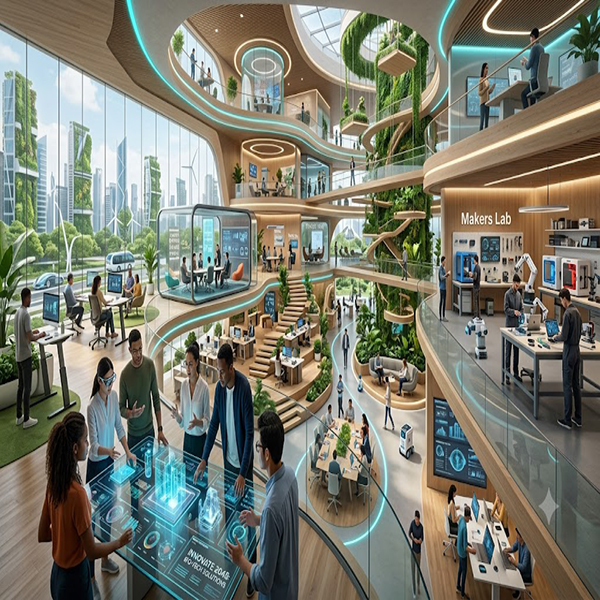
If design dictates how a business functions on the outside, it is equally critical in shaping how it operates on the inside. A company’s physical footprint is not just a container for labour; it is an active participant in the enterprise’s success. Research consistently proves that the environment you spend time in has a profound and measurable impact on creativity and the overall ability to innovate.
Human beings are deeply permeable to their surroundings. Factors such as access to natural daylight, intelligent spatial layout, acoustic quality, and the integration of biophilic elements directly influence our psychological state and physiological well-being. When employees are placed in environments that stimulate their senses and support their varied working styles, their capacity for creative problem-solving naturally expands.
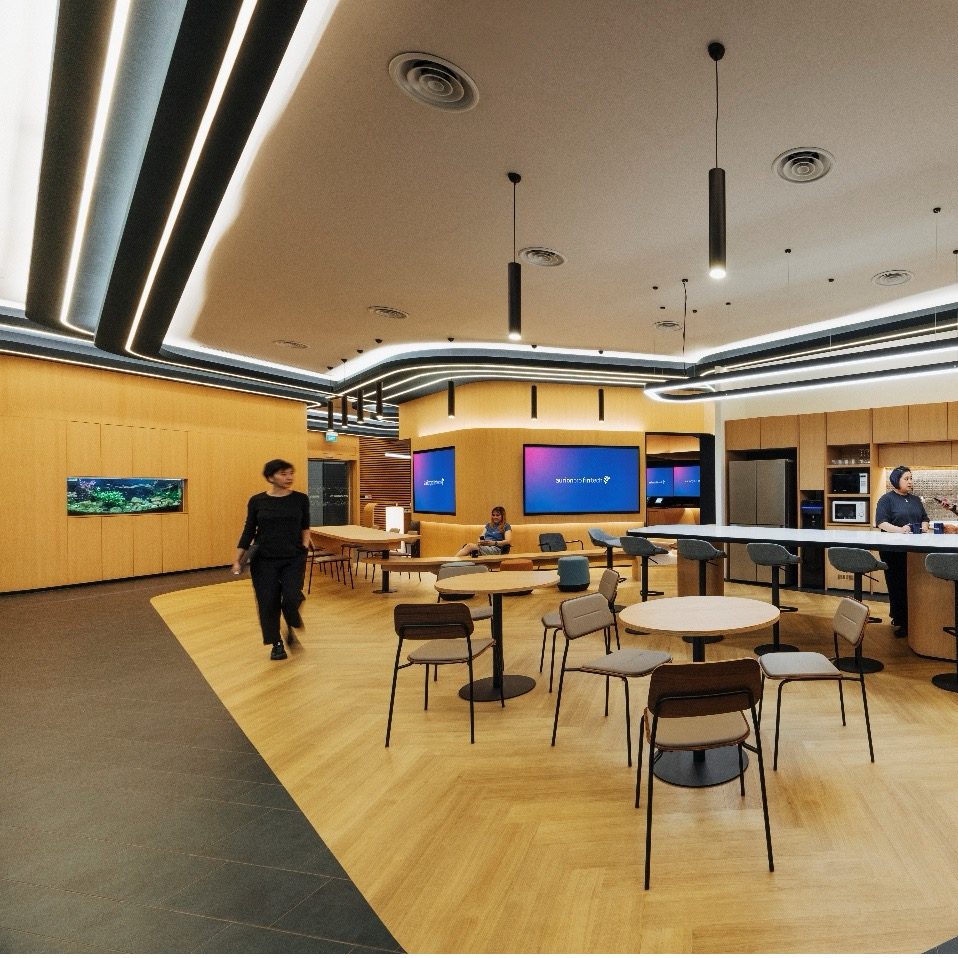
An intentionally designed environment acts as a physical manifestation of a company’s culture. It signals to employees that their well-being and creative output are highly valued. In this light, the workplace becomes the crucible of innovation.
The Stagnation of the Modern Office
Yet, despite our advanced, data-backed understanding of how physical environments shape human behaviour and performance, a glaring paradox exists in the modern corporate world. When it comes to the design of the spaces that accommodate business, the industry is still overwhelmingly driven by aesthetic convention and historic data; consequently, we see astonishingly little true innovation.
Many organizations approach real estate and office design by looking firmly in the rearview mirror. They rely on outdated metrics to dictate their future spaces, including:
- Headcounts and sharing ratios based on generic and historic attendance models.
- Standardized square-footage-per-employee ratios.
- Traditional hierarchical floor plans that allocate space by team and/or status
- Conventional planning that delineates functions rather than integrating them.
The result is often a repetitive sea of open-plan desks or rigid cubicles, dressed up in the latest trendy colour palettes with a sprinkling of collaborative spaces for good measure or fashionable, yet functionally stagnant, furniture. This superficial approach prioritizes immediate cost-efficiency and conventional aesthetics over actual human needs and future business agility.
By designing spaces based on how work used to happen, rather than how it might happen, businesses inadvertently stifle the very evolution they seek. The static nature of these conventionally designed offices renders them fragile in the face of change. When a global shift or a sudden technological breakthrough alters the nature of work, these rigid environments become obsolete liabilities rather than supportive assets. This failure to innovate in physical space represents a massive, missed opportunity for businesses striving to secure a brighter future.
Designing for the Unknown: Workplaces of Tomorrow
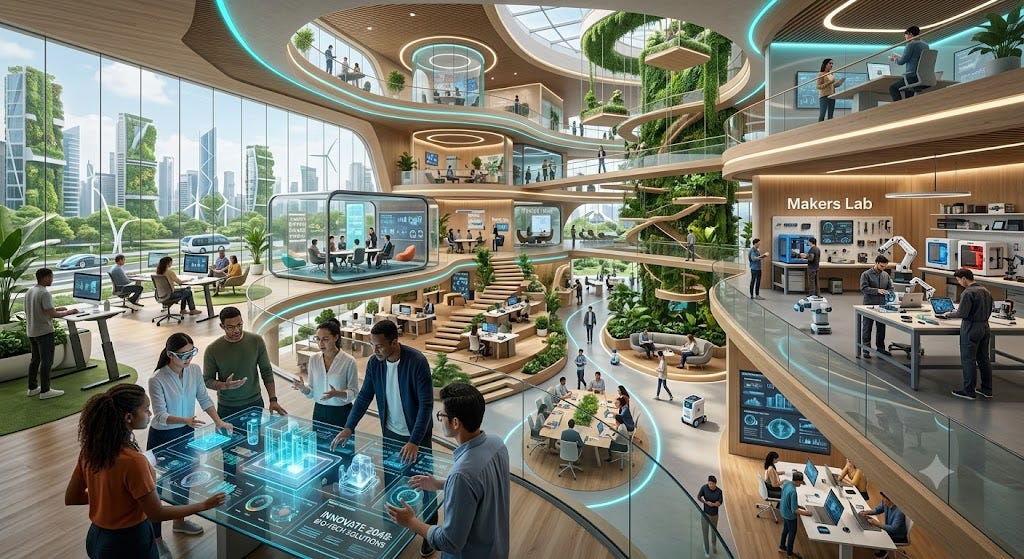
How, then, can we break free from these historical constraints? How can we develop strategies and designs for workplaces that embody innovation and support business evolution for an uncertain future? The answer lies in shifting our perspective from designing static spaces to designing dynamic, adaptable ecosystems.
To achieve this, organizations must embrace several key strategies:
1. Adopt Radical Flexibility The future of work is inherently unpredictable, meaning the spaces that support it must be entirely reconfigurable. This involves utilizing modular architecture, movable acoustic partitions, and highly adaptable furniture systems that allow employees to reshape their environment on demand. A workspace that can transition from a massive town hall presentation space to a series of intimate, sound-proofed project war rooms in a matter of hours is a space that can evolve alongside the business.
2. Integrate Technology as an Enabler, Not a Dictator Workplace design must be deeply integrated with technological infrastructure. Technology should serve as a seamless bridge between the physical and digital realms, supporting distributed teams and hybrid work models equitably. Furthermore, the integration of smart building sensors can provide real-time, forward-looking data on how spaces are actually being used. By relying on live telemetry rather than historic assumptions, organizations can continuously iterate, optimize, and right-size their environments.
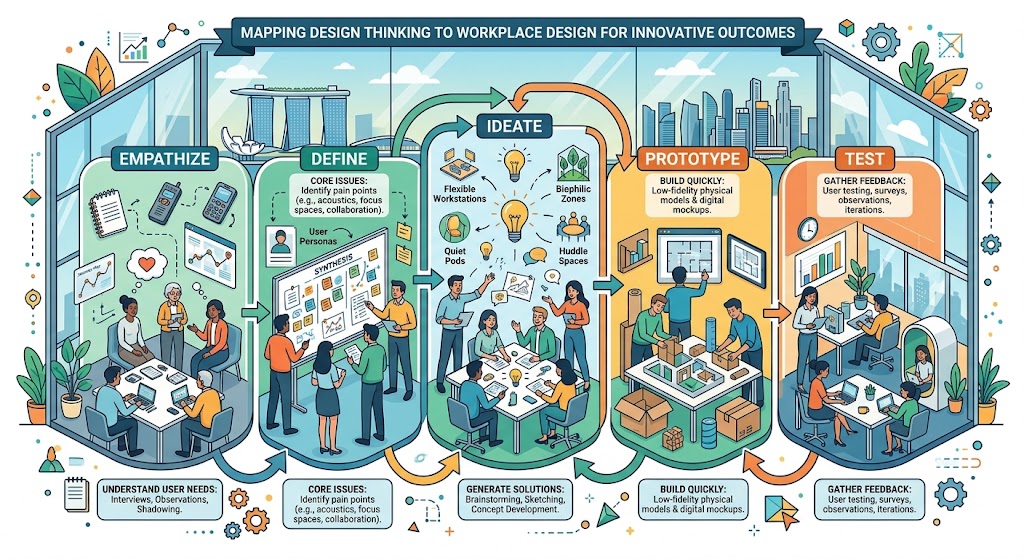
3. Transition to Experience-Driven Design Strategies must pivot from a purely metric-driven real estate approach to an experience-driven one. This begins with deep, qualitative research into the specific behaviours, challenges, and aspirations of the workforce. By employing the very design thinking principles that elevate their consumer products, companies can co-create workplaces with their employees. This human-centric approach ensures that the physical environment supports cognitive diversity, neurodiversity, and comprehensive well-being.
4. Embrace a Mindset of “Continuous Beta” Ultimately, designing for the unknown requires acknowledging that the workplace is never truly “finished.” It must function as a living, breathing laboratory. Organizations should establish pilot spaces to test new ways of working, rigorously measure the outcomes, learn from the failures, and adapt the broader real estate portfolio accordingly.
Conclusion
Design possesses the undeniable power to enable business evolution and forge a brighter, more resilient future, but only if it is leveraged comprehensively across the entire organization. We must remember that design is fundamentally about how a business works, just as much as how it looks.
While design thinking has successfully elevated corporate strategy, service delivery, and product development over the last decade, it is far past time to apply this rigorous, innovative approach to the physical environments where business actually happens. By discarding outdated aesthetic conventions and historic data in Favor of dynamic, human-centric, and technologically integrated spaces, organizations can create environments that actively fuel creativity and agility. The workplace of tomorrow must be as forward-thinking as the business it houses. When companies realize that their physical spaces are essential tools for innovation, they unlock the true potential of design to navigate the uncertainties of tomorrow.